


Every CSSD Staff Must Know for Safe Healthcare Practice
Sterilization is a critical component of healthcare facility operations, ensuring that surgical instruments and medical devices are safe for patient use. Proper sterilization not only prevents the transmission of harmful microorganisms but also plays a central role in protecting patients and healthcare workers from healthcare-associated infections (HAIs). In Central Sterile Supply Departments (CSSD), rigorous sterilizing practices are implemented to maintain instrument integrity and meet international safety standards. These processes encompass pre-disinfection, cleaning, inspection, packaging, sterilization, monitoring, and sterile storage, forming a comprehensive workflow that ensures every instrument is safe for clinical procedures.
Healthcare facilities worldwide rely on sterilization protocols to comply with standards such as those set by the Centers for Disease Control and Prevention (CDC) and international guidelines for medical device reprocessing. Properly trained CSSD staff follow these protocols meticulously, integrating aseptic techniques, mechanical and biological monitoring, and quality assurance measures to guarantee patient safety. For more detailed guidance on disinfection and sterilization in healthcare facilities, you can refer to the official CDC resource here. This article provides a step-by-step, educational guide to sterilization practices, helping healthcare professionals understand what is required to maintain compliance and ensure safe clinical outcomes.
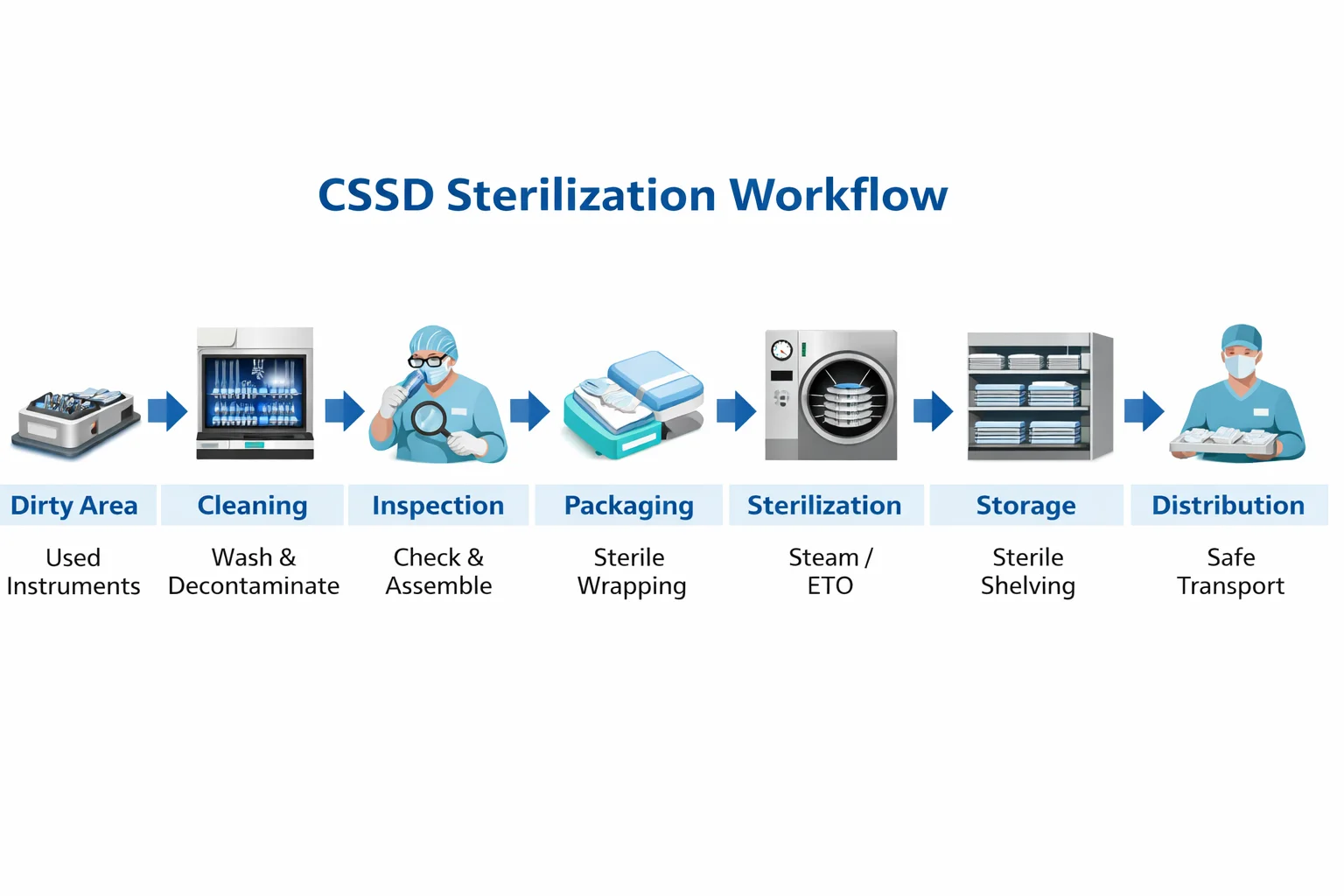
At a Glance
Sterilizing practices in healthcare facilities encompass a range of processes, from pre-disinfection to sterile storage. Proper sterilization is essential to:
- Prevent infection transmission
- Protect patients and healthcare staff
- Maintain instrument integrity and usability
- Comply with international sterilization standards
Key sterilization methods include steam sterilization and ethylene oxide (ETO) sterilization, which are selected based on instrument type and material. CSSD plays a central role in central processing, ensuring all medical devices are appropriately decontaminated, packaged, sterilized, and stored.
Overview of Sterilizing Practices
Sterilization differs from disinfection in that it completely eliminates all forms of microbial life, including bacteria, viruses, fungi, and resilient spores, whereas disinfection primarily reduces or kills most harmful microorganisms without necessarily destroying spores. Both sterilization and disinfection are essential in healthcare facilities to maintain a safe environment for patients, staff, and visitors, minimizing the risk of healthcare-associated infections (HAIs).
Medical devices and instruments undergo central processing, which is a systematic workflow integrating cleaning, inspection, packaging, sterilization, monitoring, and sterile storage. This process ensures that instruments are processed consistently and according to international standards. Proper sterilization not only preserves the functionality and longevity of surgical instruments but also reinforces patient safety by preventing cross-contamination.
Sterilization vs Disinfection (High-Value Comparison Table)
| Aspect | Sterilization | Disinfection |
|---|---|---|
| Purpose | Eliminates all microorganisms | Reduces most microorganisms |
| Effect on spores | Completely destroys spores | Does not reliably destroy spores |
| Application | Surgical instruments, implants | Environmental surfaces, non-critical devices |
| Methods | Steam, ETO, low-temperature systems | Chemical disinfectants |
| Role in CSSD | Final critical safety step | Pre-sterilization preparation |
| Infection risk reduction | Maximum | Moderate |
Central Sterile Supply Department (CSSD)
The Central Sterile Supply Department (CSSD) serves as the operational hub for instrument sterilization. Its responsibilities include:
- Central processing and distribution of sterile supplies
- Managing CSSD workflow zones: dirty → clean → sterile
- Ensuring operator competence and adherence to protocols
- Overseeing documentation, quality assurance, and compliance
Complete Sterilization Cycle (Step-by-Step)
| Sterilization Stage | Purpose | Key Standards / Controls |
|---|---|---|
| Pre-Disinfection | Prevents soil drying | EN ISO 15883 |
| Cleaning | Removes organic debris | EN 14885 |
| Inspection & Assembly | Ensures device integrity | Visual & functional checks |
| Packaging | Maintains sterility | EN 868-5 |
| Loading | Ensures proper exposure | Load configuration guidelines |
| Sterilization | Destroys microorganisms | EN 13060, ETO standards |
| Verification | Confirms effectiveness | Chemical & biological indicators |
| Storage & Distribution | Preserves sterility | Event-related shelf life |
1 Pre-Disinfection / Decontamination
The first step involves receiving used instruments and performing immediate pre-treatment. Pre-disinfection removes soil, organic matter, and biofilm. Instruments are then processed through washer-disinfectors compliant with EN ISO 15883.
Key practices: Use effective decontamination agents, handle instruments with appropriate PPE, and prevent cross-contamination by segregating areas.
2 Cleaning
Cleaning can be manual or automated and is essential before sterilization. Proper cleaning ensures that sterilants can reach all surfaces.
Considerations: Use approved agents (EN 14885), ensure full disassembly, and rinse thoroughly to remove residues.

3 Inspection & Tray Assembly
Visual inspection identifies damaged or non-functional instruments. Instruments should be assembled in trays according to best practices to ensure correct placement and adequate spacing for sterilant penetration. Explore surgical instrument sets for proper tray assembly examples.
4 Packaging for Sterilization
Packaging maintains sterility post-process. Options include sterilization wrap types, rigid containers, and peel-open pouches. Using specialized sterilizing forceps is recommended to maintain aseptic handling during this stage.
Best practices: Avoid overpacking, verify packaging integrity, and include indicators.
5 Loading Sterilizers
Proper loading ensures even sterilant distribution and adequate air circulation. Follow load configuration guidelines and separate instruments by type and size.
6 Sterilization Methods
Steam Sterilization: Uses pressurized saturated steam (autoclave). Class B autoclaves compliant with EN 13060 are standard for stainless steel.
Ethylene Oxide (ETO) Sterilization: Gas-based for heat-sensitive instruments. Requires aeration post-process; ideal for delicate plastics.

Sterilization Cycle Verification
Verification ensures instruments are sterile before use. This includes mechanical monitoring, chemical indicators, and biological indicators (spore testing).
| Monitoring Type | What It Measures | Purpose |
|---|---|---|
| Mechanical monitoring | Time, temperature, pressure | Confirms cycle parameters |
| Chemical indicators | Exposure to sterilizing agent | Verifies process conditions |
| Biological indicators | Microbial kill effectiveness | Confirms sterility assurance |
| Bowie-Dick test | Steam penetration | Detects air removal failures |
| Documentation | Records & traceability | Compliance & audits |
Monitoring, Storage & Safety
Monitoring: Continuous quality assurance includes sterility confirmation and periodic audits.
Storage: Post-sterilization, instruments are stored under controlled conditions using event-related shelf life principles. Proper air circulation and safe handling are vital.

Infection Control & Patient Safety
Sterilization is integral to infection control. Best practices include following aseptic techniques, preventing HAIs, and maintaining continuous staff training on emerging standards.
Standards, Regulations & Compliance
- CDC Guidelines for Disinfection & Sterilization
- EN 14885 – Disinfectant solutions
- EN ISO 15883 – Washer-disinfectors
- EN 868-5 – Sterile packaging
- EN 13060 – Steam sterilization
Facts & Figures
- Proper sterilization reduces surgical site infections by up to 70%.
- Global sterilization market growth projected at 6% CAGR through 2030.
- Non-compliance contributes to 10–15% of HAIs in hospitals globally.
Case Studies & Awards
- CSSD Optimization: Hospital reduced sterilization errors by 40% through workflow redesign.
- Compliance Success: Adoption of ETO sterilization improved instrument lifespan by 25%.
Frequently Asked Questions (FAQs)
What are the main steps of the sterilization cycle?The cycle includes pre-disinfection, cleaning, inspection, packaging, sterilization, verification, monitoring, and sterile storage.
How do biological indicators verify sterilization?Biological indicators contain spores that survive only if sterilization fails. Their testing confirms the effectiveness of the process.
What is the difference between steam sterilization and ETO sterilization?Steam sterilization uses high-pressure steam for heat-stable instruments. ETO sterilization uses ethylene oxide gas for heat-sensitive instruments.
How long do sterile instruments remain sterile in storage?Sterility duration follows event-related shelf life, remaining safe until the packaging is compromised or the instrument is used.
Conclusion
Effective sterilization protects patients, ensures compliance, and maintains instrument integrity. CSSD staff must follow step-by-step protocols, verify sterilization cycles, monitor quality, and maintain sterile storage. Adherence to global standards and proper training supports a safe healthcare environment and reduces infection risks.